
Whole body vibration plates are all over social media, but what does the science say about their benefits?
When my partner invited me to our local sunbed shop to stand on a mechanical vibrating plate to ease my back pain, I was sceptical. Chronic back pain has haunted me since I was a teenager, and no amount of physio, rest, or exercise has ever helped me fully recover. But like millions of people across the world, I often find myself sitting at a desk for far longer than is healthy. So on that particular day, I was desperate enough to give it a go.
Cut to twelve months later, and I write this with my feet planted on my very own at-home vibration plate, fully converted to the whole body vibration (WBV) trend. And although, admittedly, it hasn’t cured my lifelong back injury, it has definitely delivered some benefits.
You might have seen online influencers talking about their home vibration plates, but as with every wellness trend, it pays to do your due diligence before investing in new tech. With that in mind, here’s what you need to know before you decide to step onto the shaker.
How does whole body vibration work?
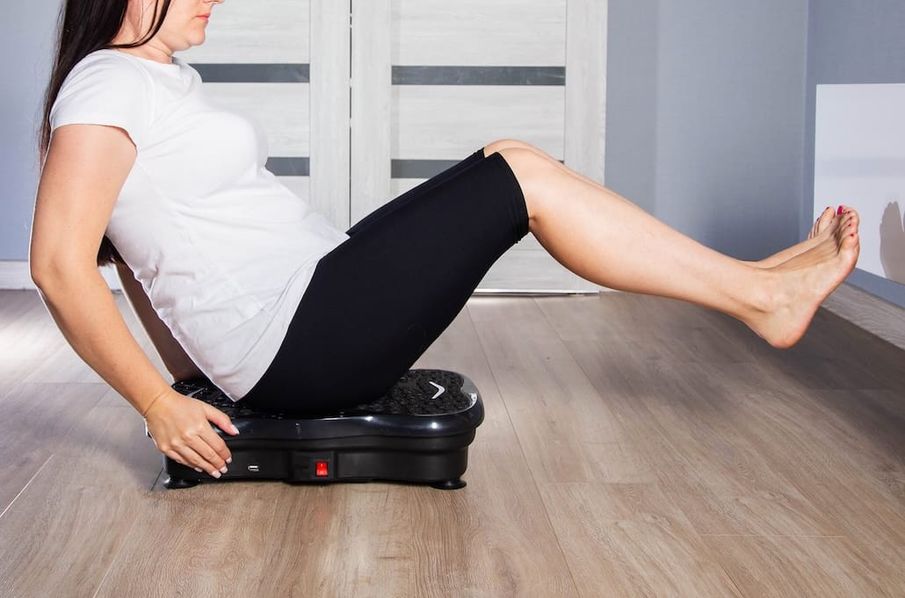
Simply stand, sit, or lie down on the electronic platform and allow the vibration to travel through your body. The movement creates a jiggling sensation, and your muscles will respond by rapidly contracting and relaxing dozens of times per second. You can also do exercises like squats and lunges on the platform, as well as static poses designed to improve overall balance.
– Are pregnant
– Have an injury or underlying medical condition
– Have had a recent fracture
– Have a joint replacement
– Use an implanted medical device
– Live with a complex health condition
What are the benefits?
WBV is described by researchers as an ‘exercise mimetic’, which means it produces exercise-like effects in the body. That means if you’re not well enough to go for a jog or make it to a workout class, stepping onto a vibration plate could bring some much-needed movement without having to leave home.
But while it can be tempting to opt for WBV as a low-effort alternative, vibration plates can’t replace the cardio benefits of a walk in the park or the strengthening of a weight-training session.
However, the good news is that there is research to suggest that shaking can be good for you in other ways. Because your body responds in a similar way to exercise, you can promote muscle growth and improve something called the stretch reflex, which is essentially how quickly and efficiently your muscles respond to movement. WBV can also prompt your body to produce more nitric oxide and boost circulation, meaning more oxygen is delivered to your organs and tissues.
It’s this boost in circulation that I suspect has been beneficial for me as a remote worker.
After sitting down all day, the shaking sensation helps loosen the stiffness in my legs, arms, and back, improving flexibility and range of movement. For me, spending 10–20 minutes on the vibration plate is more achievable than a gym session.
The reason my partner started using WBV was that she has fibromyalgia. “It makes the pain more manageable,” she tells me, “and because my energy levels fluctuate so dramatically, sometimes leaving the house to exercise just isn’t possible. The vibration plate means I can get the movement at home, which eases the pain, at least a little.”
While vibration plates certainly don’t offer a cure, evidence from a 2019 systematic review suggests longer sessions of WBV could be particularly helpful for those with chronic musculoskeletal pain, which is linked to conditions like fibromyalgia, arthritis, gout, and back pain.
And for those with osteoporosis, research suggests WBV can also help build bone density and encourage bone remodelling, but specific dosage is required here, and so shouldn’t be attempted without professional guidance.
Top tips for using a vibration plate
-
Keep sessions short and consistent. Aim for five to 10 minutes at a time.
-
Use a vibration plate alongside a wider fitness routine rather than a standalone workout, such as before a weights training session to warm up muscles and improve mobility.
-
Experiment with using it for muscle activation exercises such as squats or split squats, making the movement more challenging.
-
Use it during your cool-down to help relax muscles, ease soreness, and improve flexibility during stretching.
-
Choose low-frequency settings after exercise to support recovery or as a gentle movement alternative on low-energy days.
In a world obsessed with doing more, vibration plates are a reminder that movement doesn’t always have to be intense or high-impact to have results. And on days when movement feels out of reach, there are small, accessible, manageable ways to shake things up.
Comments