
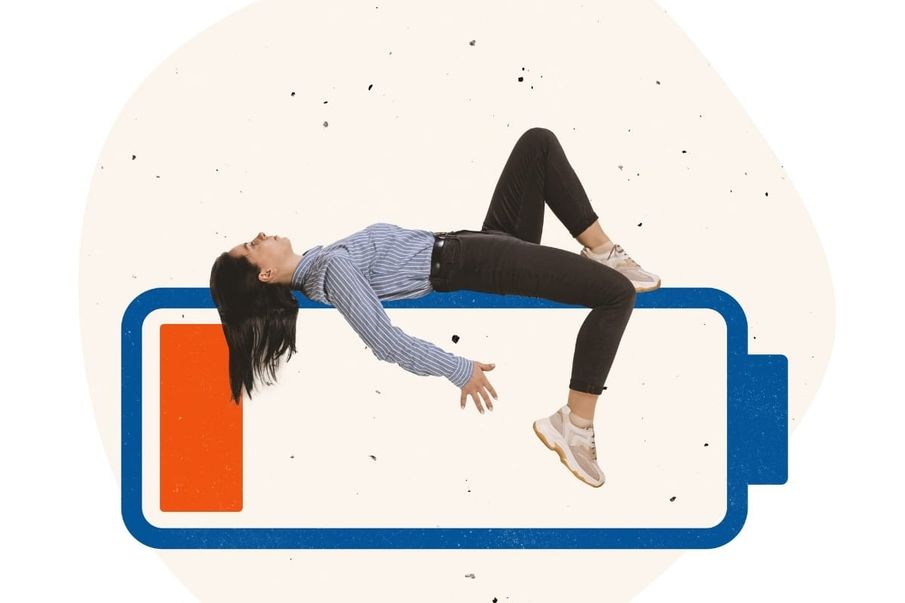
We explore the ‘broken battery’ analogy, and how it can be a helpful way of conceptualising what it’s like to live with chronic illness
Experiencing a bout of sickness can inevitably put your life on hold. Whether you’re sneezing on the sofa or healing a broken bone, more often than not, the pain and inconvenience of ill-health gradually becomes a distant memory, allowing normal life to resume.
But chronic illness – a long-term health condition that may not have a cure, and requires ongoing management via medication and/or other therapies – is a constant presence for those with conditions like fibromyalgia, epilepsy, asthma, autoimmune diseases, chronic pain, and arthritis.
Instead of a typical illness that you would hope gets better over time, chronic illness symptoms are more unpredictable, often flaring up unexpectedly, or as a result of specific triggers – which could range from psychological stress to a change in the weather. And with a 2024 report by charity the Health Foundation predicting that 9.1 million adults in England will have a diagnosed major illness by 2040, it’s a struggle faced by many.
One of the major obstacles to living with chronic illness is that it is often invisible, or at least imperceptible, to the average onlooker, making communicating symptoms tricky. Yet, a 2023 data analysis, published in Qualitative Research in Medicine & Healthcare, found that language tools, such as metaphors, allow patients to explain their symptoms more effectively to medical professionals.
Spoon theory
Created by Christine Miserandino, ‘spoon theory’ is a widely-adopted way of explaining how much energy someone with chronic illness has throughout the day, which can fluctuate greatly for each person.
The idea is that ‘healthy’ people have the energy they need to get dressed, go to work, cook dinner, etc., and that energy is represented by a number of spoons. For every task carried out, a spoon disappears. The theory goes that most people never have to consider how many spoons they have for the day ahead, yet those with chronic illness have far fewer spoons (as well as a change in this starting number on any given day), so are constantly evaluating how best to use the little energy they do have – and once those spoons are gone, they’re gone.

It’s become a popular theory among the chronic illness community, but some people find that it oversimplifies their experience, or doesn’t accurately capture their changing energy levels and symptoms.
Broken battery analogy
An alternative term that some people feel more aligned with is the ‘broken battery’ analogy.
The best way to explain this is to think about the battery in a mobile phone. When the battery is functioning optimally, you can recharge it quickly, and rely on it to power your phone for an entire day, where you can stream music, make video calls, and text as often as you like. But when the battery is faulty, or nearing the end of its life, it takes twice as long to charge, or never reaches 100%, and is almost empty by lunch time.
One of the reasons that people prefer this analogy is because spoon theory suggests that after using all your ‘spoons’ during the day, they replenish themselves overnight. “The broken battery shows the reality that recovery is not always straightforward,” explains Tina Wright, who is a cognitive behavioural psychotherapist specialising in persistent pain. “Sometimes it takes longer, and when stress or illness is present, the recharge is less effective.”
Additionally, some say that it more effectively captures the unpredictability that people with chronic illness experience in terms of energy depletion. In the same way that a faulty battery may cut out unexpectedly, someone with chronic illness can think they have the energy for particular a task, and then hit a wall out of nowhere.
It also helps to demonstrate how some activities require more effort than others. “Just as different apps on a phone drain power at different rates, so too do exercise, work, relationships, or even worrying,” says Tina. “This makes the analogy very relatable, and it helps people see that fluctuating energy is not their fault, but part of how their body now works.”
Running on fumes
One of the challenges with chronic illness is the loss of identity. “Many people say, ‘I don’t recognise myself anymore.’ Chronic pain can take away roles, hobbies, or work that once defined them,” says Tina.
According to one 2020 study, published in the journal Sage Open Medicine, sadness, worry, and despair, are common emotions for those with chronic illness, often as a result of the stress of coping with circumstances, or not being able to fulfil their expectations in life.
This disconnect between past and present capabilities, can come with layers of grief, sadness, and anxiety, but with the help of analogies like the broken battery, people can come to terms with their symptoms, and find new ways to cope.
On a psychological level, having a visual representation of a broken battery can be a relief, because it makes the invisible visible. Tina notes that over time, people can go from feeling frustrated and angry at themselves to accepting their new normal: “That change in mindset reduces self-blame and helps people make kinder choices.”
It helps on a practical level, too, allowing them to look for patterns around what activities are particularly draining. “A physical workout, a stressful conversation, or an afternoon of concentration, all draw from the same source,” says Tina, “and understanding this makes it easier to plan, to explain their needs to others, and let go of guilt. For many people, this model is the first step towards acceptance, and building a more balanced and compassionate way of living with their condition.”
But, just like spoon theory, not everyone identifies with the broken battery analogy. Understandably, the term ‘broken’ can feel stigmatising, or suggest that you are damaged in some way – which is, of course, not true. It also focuses mainly on energy levels, without considering other facets of chronic illness, such as aches and pain, brain fog, sensory issues, or mobility problems.
Rest and recharge
Whether you identify as a ‘spoonie’, or resonate more with the broken battery analogy, the important thing to remember is that there is support available. In terms of energy levels, Tina suggests ensuring that while we may have to prioritise work tasks, household chores, and rest, we mustn’t forget to make time for fun as well.

“Work means your responsibilities and the things that need to be done, whether that is paid employment or household tasks. Rest is about genuine recovery for body and mind, through sleep, relaxation, or quiet time. Play is just as important. It means the things that bring enjoyment, creativity, and connection.”
She also encourages people to keep tasks small and frequent, and to leave space each day for flexibility. “Some days you will manage more, and other days less, and that is part of learning how to live with a chronic condition. What matters is that you make space for all three parts of the structure, so life is not just about chores and recovery. Over time, this creates a routine that feels balanced, sustainable, and kinder, both physically and emotionally.”
Comments