
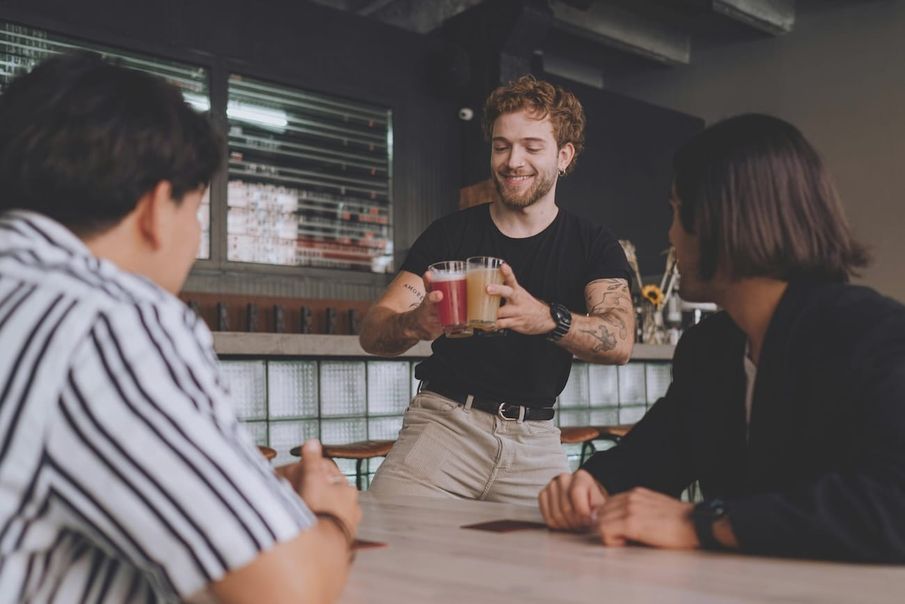
A lot of people associate socialising with drinking, but embracing sobriety or wanting to reduce your alcohol intake doesn’t mean you have to miss out on fun
Picture it: your local pub on match day, laughter echoing as you sip on your pint. Or maybe it’s a birthday party, and someone’s already topped up your prosecco before you finish your first glass. Perhaps you’re curled up on the sofa, takeaway in hand, with a deep red swirling in your glass after a rough week. Now, imagine all of those moments without any of the alcohol.
For some, the thought feels impossible. The booze is baked into these moments like gravy on a roast dinner, so if your first thought is, “I couldn’t get through that without a drink,” I get it. I’ve been there. But I promise you: it is doable. It’s just not always easy.
For me, sobriety has become a superpower. Not because I have suddenly mastered every social situation, but because I have discovered new activities that I genuinely love, like wild swimming, running, and getting experimental in the kitchen. I’ve started leaning into things I used to ignore. I’ve found peace in quiet mornings, energy I didn’t realise I was missing, and a weirdly satisfying love for reading the kind of self-help books I used to roll my eyes at.
Do I still head to the pub? Yep. Do I go to weddings? Absolutely. However, I experience them differently now, and I’d argue better, in many ways.
Finding the ‘fun’ in sober social functions
One of the most nerve-racking sober moments I’ve had was attending my first wedding without consuming any alcohol.
It was my brother-in-law’s big day, and I knew the booze would be flowing. I was dreading it.
So, I prepped. I rang the venue ahead of time to check if they served alcohol-free beer (they did). I also brought my own alcohol-free drinks, and stashed them in the boot of my car. I stuck with people I knew wouldn’t be knocking back pints. I drove, which gave me an escape plan and a bit of control. Most importantly, I opened up to my partner about how anxious I felt going into the day. The result? I had a brilliant time, I made new mates, and I remembered every moment.
Another memory that sticks out was going to gig completely sober – Run the Jewels at Brixton Academy, in London. I was also totally alone. Normally, I’d have had a couple of pints pre-show, and then topped up between acts – especially when there wasn’t a distraction of company. But this time, I didn’t.
I worried I wouldn’t enjoy the atmosphere or feel the same high. But guess what? I remembered every single song, every lyric, every beat drop. I wasn’t dehydrated. I wasn’t distracted. And I didn’t spend half the night queuing for the loo. I’d say that’s a win-win situation.
Changing the narrative
I’m not the only one navigating this shift in sober living. In 2022, an NHS Health Survey for England found that 25% of 16 to 24-year-olds were teetotal – the highest percentage of any age group. Health, mental wellbeing, and hangover-free Sundays, are big motivators. Social media’s role can’t be ignored either. It’s become a powerful mirror, showing us the impact of alcohol on our lives.
In a broader look, about 16% of men, and 22% of women, identify as non-drinkers, according to the same NHS survey. And, perhaps surprisingly, in many social groups, it’s the non-drinkers who now choose the venues. The ‘Raising the Bar’ Everleaf X KAM report revealed that two-thirds of adults say sober friends influence where they go out, which rises to 85% of 18 to 24-year-olds, often picking places with solid alcohol-free options.
We’re also seeing alcohol-free drinks take centre stage at festivals, in supermarkets, and restaurants. Big chains are finally cottoning on, and it’s about time.

Still, the road isn’t always smooth. More than half of UK drinkers admit they’ve used alcohol to help with stress or anxiety, according to a survey by Alcohol Change UK, but 44% say it actually made their mental health worse. Add to this the findings of a 2020 YouGov survey, which highlighted that 12% of Brits experiencing loneliness also report drinking to cope.
So, how do you navigate social situations sober?
Whether it’s your first dry Friday night out, or a big family bash, here are five top tips on what’s helped me enjoy socialising while sober – that might just help you, too.
1. Find your favourite alcohol-free alternatives
Nowadays there’s a whole world of quality 0% beers, proseccos, wines, and spirits at your disposal. Test a few to find what you like. Trust me, sipping a well-made alcohol-free G&T feels just as good with mates around. A decent glass of 0% red with your dinner hits the spot. Plus, they’ve come on massively in the last couple of years.
2. Talk it out before you head out
Whether it’s with your partner, sibling, or a friend, have a chat about how you’re feeling beforehand. Playing out the scenario can seriously calm your nerves. You’d be surprised by how many people are quietly trying to drink less, too, and your honesty might open up space for them to do the same.
3. Step away when you need to
If the environment starts to feel overwhelming, take a breather. Pop to the loo, grab some fresh air, or scroll your phone for a minute. You’re not bailing, you’re protecting your peace. Not every moment of a social event has to be performative, or high-energy.
4. Suggest new kinds of hangouts
There’s a life outside of pubs, I promise. Go for a group walk. Try axe throwing. Get into paddleboarding. Host a dinner party where booze isn’t the main event. Or go old-school with board games and good music.
5. Find sober community spaces
I’ve really found this to be a game-changer. Sober communities like Sober Girl Society, Club Soda, and Bee Sober are out there and growing fast. They host events, walks, brunches, and socials where everyone’s navigating similar stuff. It’s not about ditching your old friends, but adding some new ones who really get it. And sometimes, you just need that one person who won’t look at you funny when you say: “I’m good without a drink, thanks.”
The bigger picture: sobriety is getting more social
Non-drinkers are now shaping how we socialise. More and more venues are being chosen for their inclusive drinks menus, and AF offerings. That’s a huge shift.
Still, there’s work to do. Many bars and restaurants hide their alcohol-free drinks in a tiny corner of the menu, if they list them at all. There’s a golden opportunity here for businesses to meet the demand for, and normalise, sober choices. Because here’s the truth: not drinking doesn’t mean you’re missing out. If anything, you’re opting in – to clarity, connection, and next-morning memory retention.
Comments