
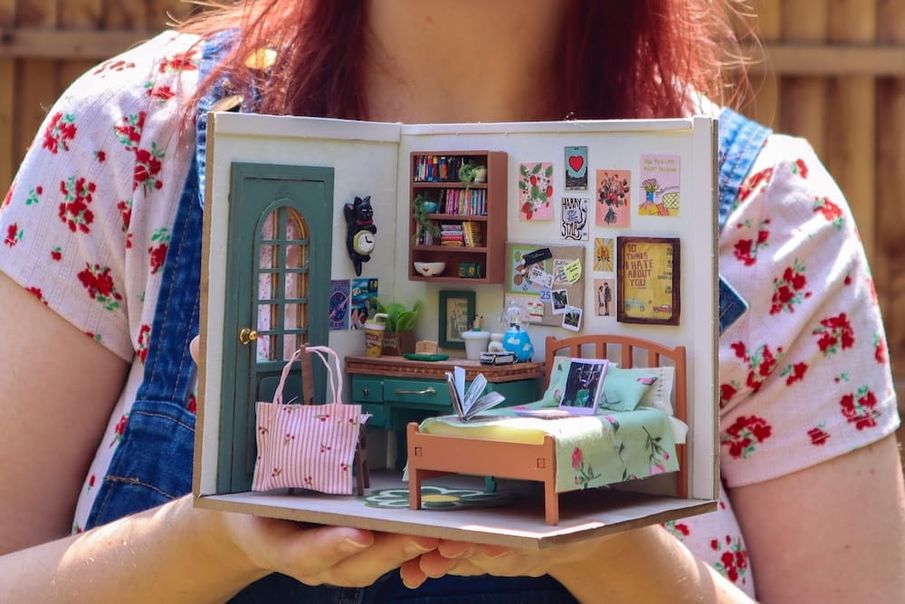
Take a peek inside the world of miniature-making, and discover there’s more to this trending hobby than first meets the eye…
I got a wooden dollhouse as a birthday present when I was little. I used my chunky, very noughties, camcorder to film inside the tiny rooms and, on the little camcorder screen, the forced perspective made the rooms look lifesized. It was all very cool and cinematic to an eight-year-old. And since then, I’ve always thought there was something magical about tiny things – from dollhouses to figurines, and LEGO to Christmas villages, toy cars, and even model trains.
But why do so many of us love all things miniature? What is it about them that makes us feel warm and cosy? It could be because the small-scale grabs our attention, making us nostalgic for childhood and the toys we coveted. Or maybe we’re awe-struck by the craftsmanship and attention to detail that goes into miniature model making. Or perhaps it gives us a feeling of calm and control in a big and chaotic world.
The not-so-tiny rise of miniatures
Before finding miniatures, Ellie Roberts had always dabbled in different hobbies, from cross-stitching to painting. But many of those kits, boxes of paints, balls of yarn, and other projects ended up stashed away in a cupboard, half-finished. “I thought this might be the case again when I picked up my first miniature model kit in 2022,” she says, “but it was the opposite. It was the first hobby I enjoyed so much that it stuck.”
After making every kit she could get her hands on, Ellie started creating her own models from scratch. She now has more than 16,000 Instagram followers admiring her creations and learning from her techniques on her account @miniaturesbyellie.
Whatever the reason for our love of all things tiny, miniatures are rising in popularity around the world. DIY ‘book nook’ kits are all the rage, Jessie Burton’s novel The Miniaturist became an international bestseller and was adapted into a TV series, and miniature tabletop wargame Warhammer 40,000 is now played by an estimated 3.5–5 million people worldwide.
It’s a fun, absorbing hobby that more and more people are adopting. And it tracks that working with miniatures is also beneficial for our mental health.
How miniature model-making soothes the mind
In 2025, a study on miniature mindfulness, published in Religion, surveyed people who assemble and paint Warhammer models. The game involves players spending hours carefully crafting small-scale models to be used as game pieces, a task that requires deep concentration, patience, and a steady hand trained over time.
Through long-form interviews and journal entries from the survey participants, researchers found that it was an ‘expansive hobby with a range of engagement nodes’. With their mind and body working together on an intricate and slow-moving task, participants developed the ability to easily enter a flow state of ‘embodied cognition’, and would lose track of time and forget outside distractions.
Another study, published in the Journal of the American Art Therapy Association, tested levels of cortisol (a biological marker of stress) found in the saliva of participants before and after art making, and saw that the activity significantly reduced stress and anxiety after just 45 minutes. Participants experienced ‘an evolving process of initial struggle to later resolution’, which allowed them to get lost in their work, and the art-making itself was helpful for learning about new aspects of themselves.
In a world of instant gratification (think one-click purchases, next-day delivery, and immediate access to an unfathomable amount of content online), there are now very few aspects of daily life that go at a slow, gentle pace. But building, painting, and making miniatures simply can’t be rushed. That’s what makes it such a peaceful and beneficial hobby for both our brains and bodies.
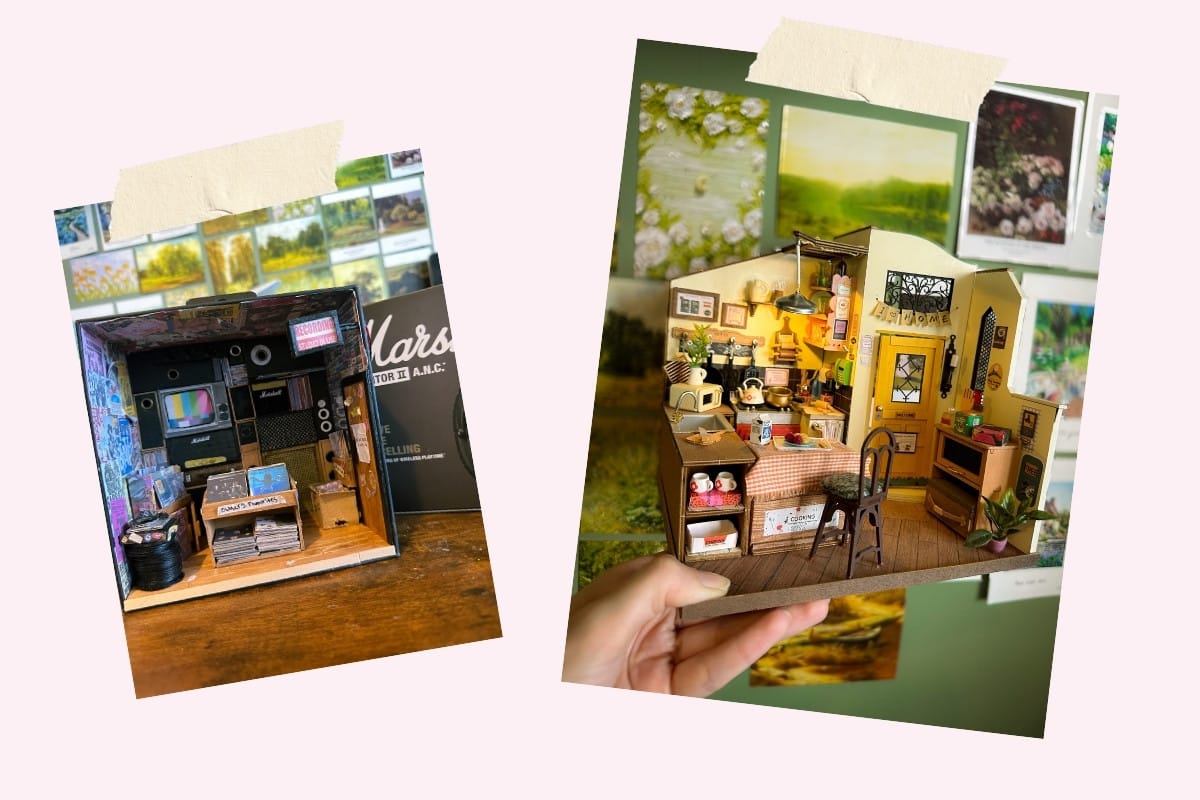
Ellie has also found that this craft alleviates her stress and anxiety. Not only did working with miniatures evoke joy and imagination for her, but it also had a wonderful therapeutic effect. “Not to be dramatic, but miniature making has saved my life,” she says. “I had some pretty devastating things happen in my life around the time I started making a miniature record shop, and it was the only thing that got me out of bed in the morning.” When she got into the flow of making this model, Ellie found that concentrating on the task gave her a break from a constant stream of anxious thoughts.
She also explains that being autistic means she often struggles to find the right words to describe how she feels. But working with her hands, and building and painting miniatures from scratch, gives her a way to express herself without having to say a thing.
How do I get started?
“Be patient with yourself!” Ellie recommends. Her advice to beginners is to get a kit that comes with all the pieces required, along with detailed instructions that break the project down into small steps, to make it feel more doable and less intimidating. “It really is the perfect way to learn the basics and to start building up your own miniature supplies, as there are almost always leftover materials and tools that you can save for another project.”
Remember the old saying: fools rush in where angels fear to tread. That should be your mantra when making your first few miniature models. Don’t rush through the instructions and risk making avoidable mistakes. Read through all the steps (or at least two to three steps ahead) to make sure you do everything correctly. Most importantly, this approach means you’ll give yourself time to enjoy the process, which is the whole point, after all.
If you want to take up this engaging and therapeutic hobby, start with a good-quality beginner kit. Progress at a gentle pace and be patient with yourself. You’ll find that this pastime soothes your mind, makes you slow down, and sparks joy and creative play. Why not try it? Make something tiny and reap huge rewards
Comments