

Uncovering a powerful, philosophical perspective on fulfilment
A scan on social media typically offers quick fixes for nearly everything, from side hustles for making some extra cash to the latest wellbeing trend to transform your sleep routine. We digest rapidly-delivered bites of information, and want immediate results. Even decisions that have a long-term impact – e.g. choosing a job or a romantic partner – can be influenced by our quest for momentary joy. We ask ourselves constantly: “What is going to make me happy now?”
But there is another form of happiness that focuses upon achieving meaning and purpose – a life well-lived. However, succeeding in this often means negotiating experiences that might require us to feel uncomfortable, scared, stressed, or even unhappy for a time. For this reason, we might choose to avoid these experiences, even though they could prove valuable in the long-run.
The ancient Greeks had a word for this kind of happiness, ‘eudaimonia’, and it was described extensively by the philosophers Plato and Aristotle. It essentially means fulfilment, but it’s a tricky concept, especially for a modern audience. As The School of Life describes: “It is eminently possible to be fulfilled and – at the same time – under pressure, suffering physically or mentally, overburdened, and, quite frequently, in a tetchy mood.”
It continues: “Many of life’s most worthwhile projects will – at points – be quite at odds with contentment.” It is tough to persuade ourselves that these projects are worth all the pain they bring, especially as fulfilment might take weeks, months, or years to achieve.
“As humans, we have a tendency to seek instant gratification, and gravitate towards pleasure over pain – also known as the pleasure principle,” explains Anita Guru, who has worked in learning and organisational development for nearly 20 years. As Anita goes on to say: “Even our brain rewards instant pleasure, and releases dopamine when we receive instant gratification. So, given we receive so much reward for short-term achievements and goals, it has become harder to focus on longer-term goals.”
It is especially hard when those longer-term goals include barriers to overcome, and the potential for distress. She gives an example: “From a behavioural perspective, if we get a dose of happiness by choosing a night out with pals over starting long-term therapy to help with our sadness over a breakup, this creates a scenario of short-lived happiness over committing to feeling pain over a period of time.”
Nobel prize-winner Daniel Kahneman describes the distinction as one of outlook – “being happy in your life” versus “being happy about your life”. There are nods to it in everyday moments – the cry of ‘carpe diem’ or ‘seize the day’ versus pushing ourselves physically to achieve long-term fitness, or slugging it out in a job we don’t like to eventually follow a dream. The journey will not be enjoyable – it could even be wrought with suffering – but the end result will be fulfilment.
Author and health coach Kate Rowe-Ham understands this complexity. “I think we put off doing things that make us feel uneasy, because the fear of the unknown is real. We don’t like to live outside of our comfort zones, but I believe if we can push on, and work through to do the thing that is making us feel discomfort, or momentarily unhappy, then real growth can happen.”
A 2018 study, published in The Journal of Positive Psychology, spotted this difference, but categorised it as experienced happiness (“where you experience happiness on a moment-to-moment basis”), and remembered happiness (“where afterwards you will reflect back and feel happy”) for either a longer timeframe (i.e. next year), or a shorter timeframe (i.e. the next day). The team surveyed 1,145 participants, and found that 79% chose experienced happiness over remembered happiness when choosing for their life, and 65% for their next year.
The split between the two types of happiness became far closer when participants were asked about what they wanted for the next hour or day. It was as if the notion of remembered happiness became too nebulous to seem obtainable when longer time frames were being considered. Eudaimonia, after all, requires endurance, but also the ability to see beyond the moment into, potentially, the far future – and this is something we struggle with.
But how do we recognise that our quest for ‘experienced happiness’ might be impacting our decision-making? Anita suggests looking out for avoidance behaviours when it comes to decisions related to long-term fulfilment. We might ruminate about a decision – playing a negative thought on loop in our mind – or catastrophise, where we assume or predict the worst-case scenario. She terms these “mind traps”, adding procrastination to the list.
Leaving this kind of behaviour unresolved can manifest physically. “If you are developing more aches and pains, or have disrupted sleep or fatigue, these can also be indicators that something needs to be addressed. You could also notice an increase in feelings of anxiety, which also manifests physically with an increased heart rate, inability to concentrate, and, at worst, panic attacks,” Anita explains.
In the moment, surrounded by noise and chaos, with things to do and people to meet, deadlines to hit and money to make, the idea of striving for a life well-lived can feel far too big to be realistically achievable. The thought of adding more stress and strife to our lives is incredibly tricky to get beyond. The School of Life speaks of “striving to do justice to your full human potential”. This feels huge. However, being aware of the concept of eudaimonia might make times of struggle more bearable, as you strain to look forward to that moment of triumph and achievement.
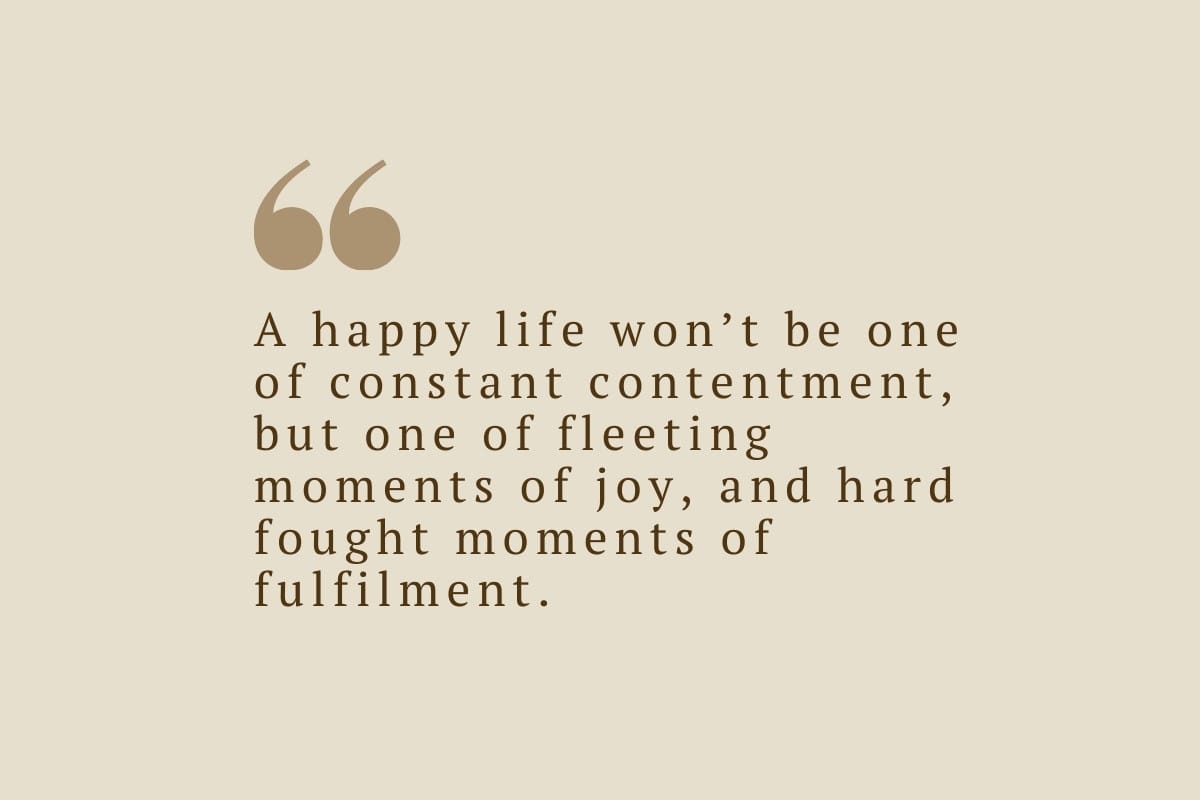
It is also an acknowledgement from the distant past – and reinforced for centuries since – that a happy life won’t be one of constant contentment, but one of fleeting moments of joy, and hard-fought moments of fulfilment. Just because we aren’t always happy, doesn’t mean we can’t achieve a life well-lived.
Comments