
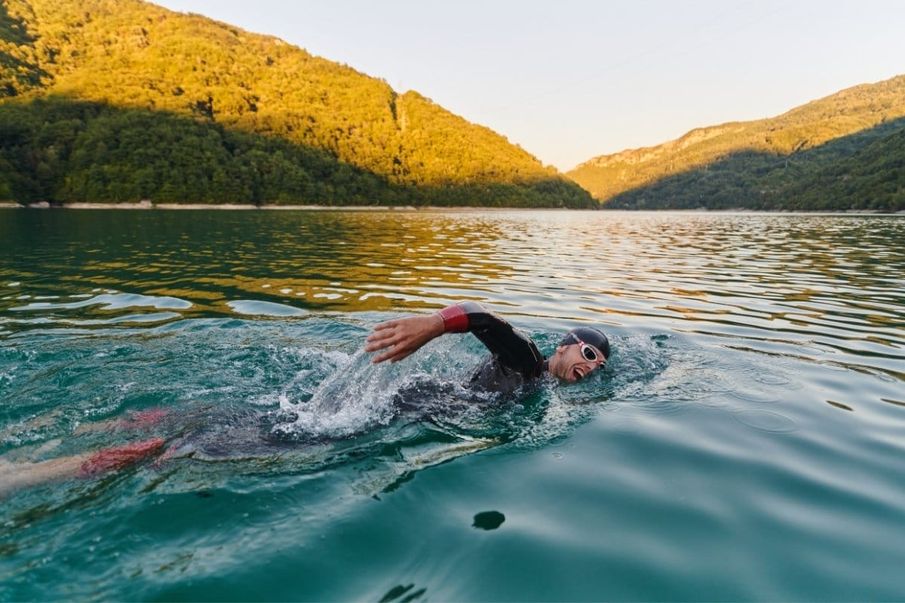
What wellbeing benefits lie below the surface of this wild and wonderful hobby? Here, author and outdoor swimmer Joe Minihane invites you to take the plunge
The river is flowing at a stately pace beneath a high summer sun. Stands of alder line its banks. Sheep graze the fields beyond. A pair of buzzards circle on the thermals above, their high-pitched calls the only sound on this hot and humid day.
Where the bank drops, I put down my things and quickly pull off my clothes, save for a natty pair of red swimming shorts. The feel of wet mud beneath my toes is cooling, grounding. I stride into the deepening water, the contrast between the cold water and the hot air placing me completely in the moment. My breath slows as I lower myself into the depths and swim out into the main channel.
From here, I have a frog’s eye view of proceedings. A coot pottering about where the undergrowth tumbles down below the surface. Air bubbles from unseen fish. It is an angle on the world that can only be gained by placing myself within the scene, rather than looking out over it.
I feel infinitesimal beneath the vastness of the sky, and what lies beyond our atmosphere. I feel at peace. This is why I swim outside.
“When everything in my personal and professional life feels too much, and the wider world feels scary, heading out to a natural body of water is a great reset,” says Ella Foote, author of How To Wild Swim and editor of Outdoor Swimmer magazine. Ella also runs her own wild swimming travel company, Dip Advisor.
“The water will still ripple and reflect the conditions each day, the birds sing, and the flowers and fauna continue their cycles. Rivers continually move, tides ebb and flow, and lakes lick shorelines, never mind what rages in the human world.”
I am drawn to the water for the same reasons as Ella. Struggling with lifelong anxiety and depression, in my early 30s I discovered that swimming in cold water was the ideal way to slow my brain to a more manageable pace. I found inspiration in the works of the late naturalist and swimmer Roger Deakin as I began my own journey swimming around the UK, exploring new spots and meeting like-minded people.
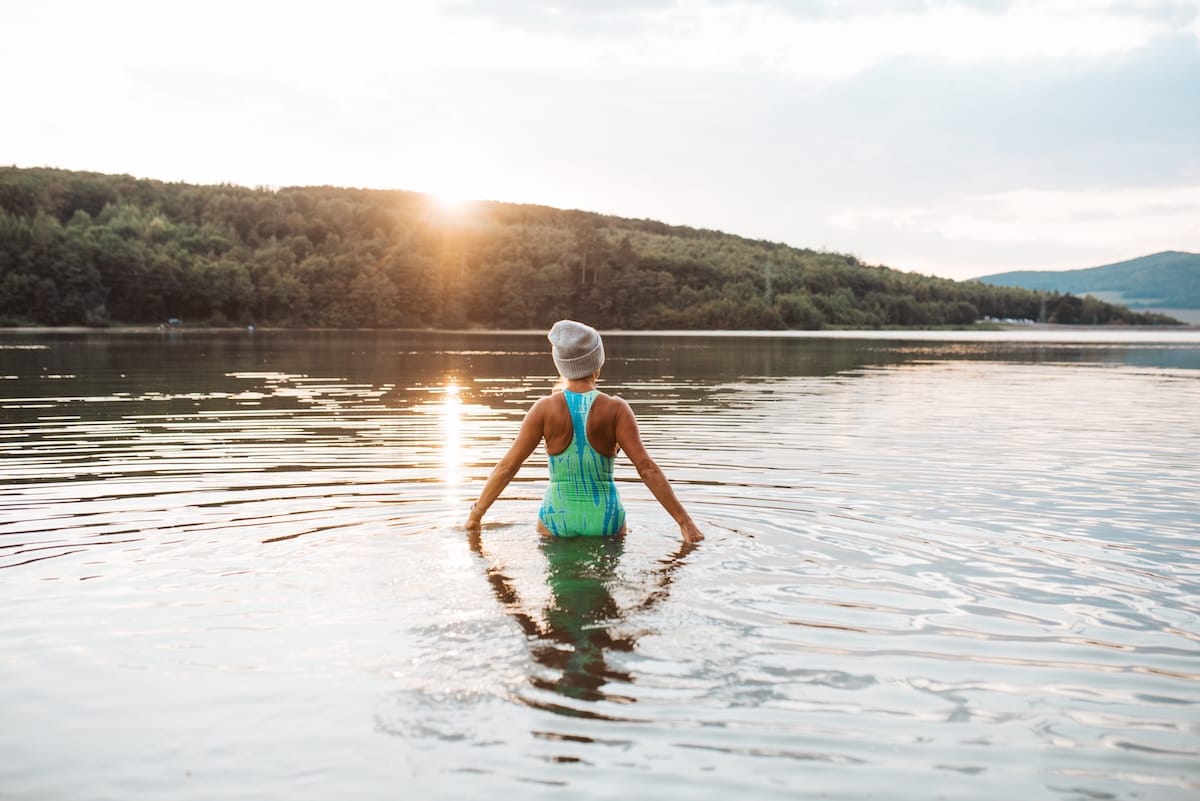
“Natural water has always had the magical power to cure,” wrote Deakin in his seminal book Waterlog, published in 1999. “I can dive in with a long face and what feels like a terminal case of depression, and come out a whistling idiot.”
Deakin’s work presaged a boom in wild swimming in the late noughties, before it truly exploded in the wake of the Covid 19 pandemic. The Outdoor Swimming Society (OSS) saw its membership expand from 300 in 2006, the year Deakin died, to over 200,000 in 2023. In a post-Covid survey, the OSS found that 94% of respondents swam for joy, with 55% saying they did so for spiritual reasons, connecting with nature and a deeper sense of self.
This spiritual connection has been the greatest gift that swimming has given me. When I swim in a river, lake, or the sea, I feel a profound sense of being part of something much wider.
While the spiritual benefits are personal, the scientific aspects of cold water benefits are becoming more evident. Since 2025, a team of researchers at the University of Portsmouth, in conjunction with Sussex Partnership NHS Trust, has been conducting a world-leading study, called Outside 2, on the benefits of cold water immersion. It’s due to report later this year. Smaller studies by the same researchers have already shown the benefits of cold water for improving mental health.
“All the research that is out there points in the direction of outdoor swimming being a good way for many people to manage depression and anxiety,” says Dr Mark Harper, a consultant anaesthetist at Sussex University Hospitals and author of Chill: The Cold Water Swim Cure.
“Most of the benefits derive from the plunging, although you need to be in the water until you regain control of your breathing and the initial shock has passed. This may be no more than a minute or two in really cold weather. However, swimming will bring the additional benefits of exercise and the joy of being out in nature.”
Science is in the process of showing what many outdoor swimmers already know: spending time in cold water is good for you.
It’s something Amy Liptrot, author of the bestselling memoir The Outrun and a keen outdoor swimmer, has been expounding for years.
“I live in a town at the bottom of a valley and, particularly in the winter, it’s important for me to get up onto the hilltops where I can swim and get some light, which is essential to my mood. I often feel reluctant, but I have learned that even a short dip is a really big boost that will last the entire day. My anxiety is often blasted away, and I feel renewed.”
Like Mark, Amy also points out that it isn’t just the swims themselves that are mood boosters, but rather everything that comes with them.
“It’s getting outdoors, being in nature, experiencing the different weather and the different seasons.”
Outdoor swimming can also provide essential social connections.
“Where there is water, there is often community,” says Ella Foote. “Even if I seek a solo swim, I will encounter others. Community is another reminder that people can be kind, and people seek to care for others, especially among swimmers.”
This was perhaps the biggest joy for me in the wake of swimming’s boom during and after lockdown. Living in Brighton and swimming off its famous beach, I would encounter the same people day after day. Some days, we would swim to the buoys laid out to mark the dedicated swimming area. On others, we would compare notes about conditions and temperature. Names were never exchanged, but we shared an interest, and that was enough. At a time of great isolation and loneliness, these connections helped build my confidence when my mental health was not at its best.
Like Ella and Amy, the simplicity and beauty of outdoor swimming is what makes it such a key part of my life. I always come away feeling refreshed, buoyant and carrying a greater sense of perspective. So why not give it a try? Come on in, the water’s lovely.
Outdoor Swimmer’s Ella Foote reveals what to consider
before diving in.
Can you swim? “It seems like an obvious question, but it is a common reason for fatalities. Ask yourself: ‘How comfortable am I out of my depth? Can I tread water while keeping my head above the water? Can I float on my back?’
Is it cold? “Water temperatures in rivers, lakes, and coastal areas are cool in spring, and even in a heatwave will always be cooler than your core body temperature.”
Tides and currents. “If you are visiting the coast, if possible, find a lifeguarded beach.”
Rivers. “Water travels faster when a river is shallow or narrow. Ensure you know where you are getting out before getting in.”
Lakes, reservoirs, and quarries. “As a rule, avoid reservoirs and quarries. They are often private facilities and are not designed for swimming.”
Trust your instincts. “If something doesn’t feel right, trust that. If the water doesn’t look or smell right, don’t get in.”
Joe Minihane is the author of the wild swimming memoir 'Floating: A Life Regained' and the guidebook 'Swim London'.
Comments