
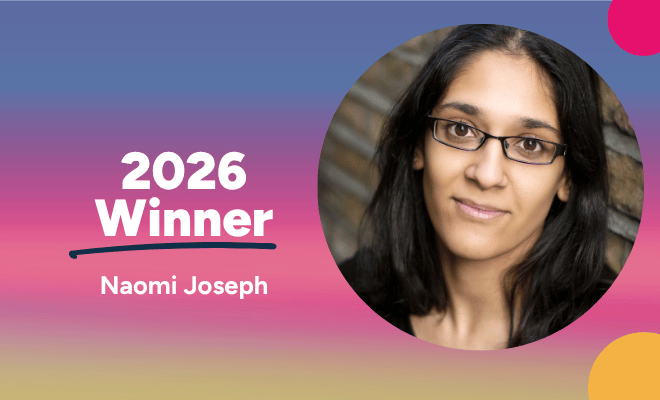
'The F Word' by Naomi Joseph was named the winner of the Happiful Poetry Prize 2026.
Here, Naomi shares why she writes in seasons rather than routines, how she knew her winning poem was finished, and why trying to be clever is one of the biggest mistakes new poets can make.
Feeling inspired? Learn more about the 2027 Poetry Prize which opens on 1 September, 2026.
Hi Naomi, congrats on winning the 2026 Happiful Poetry Prize! How long have you been writing poetry?
For as long as I can remember! Ever since I was little, I’ve always enjoyed writing in different forms and styles, and I’ve carried that into adulthood – in fits and bursts sometimes, but it’s always there.
What does your writing life actually look like day to day?
Day to day is hard to pin down. My writing life changes depending on what else is happening.
I tend to think about writing in terms of seasons and systems rather than a strict daily routine. For me, it’s more helpful to set a goal for a particular project and then think about how I can realistically make time for writing that week or month.
I don’t follow a fixed routine like "write every day from 8am–9am" because, for me, that isn’t always realistic or practical. Instead, I build writing into my life in a way that works with the season I’m in and the commitments I have at the time.
I've actually found that I’m more productive when writing isn’t my sole focus. When life is busy, I really relish a spare moment to sit and write, and I tend to use that time well.
"I think about writing in seasons rather than routines."
At the moment, what works best for me is blocking out writing time and bookending it with other activities. It helps because I don’t feel overwhelmed by large stretches of writing time, and if I’m on a roll, it gives me something to return to in my next session rather than feeling like I’m starting from scratch.
Like all writers, I have my moments where I fantasise about writing all day, but actually I find that when I do have a clear day, the blank page is intimidating.
I've realised that writing doesn’t have to mean being chained to a desk. It can mean living life so you have something to write about, going for a walk to let ideas percolate. It can even mean reading or painting. Writing doesn’t have to look a particular way.
Having said that, it’s nice to romanticise the process a little. I have tools in place which help me set the mood: my notebook, my favourite pen, and a hot drink. It’s about creating a space where I feel ready to write.
Can you tell us about the process of writing your winning poem?
I really enjoy writing to a brief and a deadline. I find having those boundaries makes it much easier for me to focus, knuckle down and write. That's what gave me the push to submit to the competition.
The theme of mental health was something I was already interested in exploring, so when I saw the brief, I felt drawn to it.
I started by writing in a stream-of-consciousness style, with no censoring or editing as I wrote.
"Sometimes when something is specific, ironically that can make it more universal."
I found that the brief unlocked lots of thoughts and feelings I'd been carrying but hadn't yet put down in one place. Writing the poem became a way of giving those ideas shape.
I always read my work out loud to see how it flows, and that helps inform any edits to the wording or rhythm of the piece.
I submitted the poem pretty much as soon as I wrote it, which isn’t always the case. Some pieces need more time or editing, but this one just felt right. I trusted myself and went with my instincts.
Did you experience any imposter syndrome around your poetry? What helped you submit it to the competition?
No, because I felt like I was writing for myself, not with the intention of "this better be good" or "I must win".
If others take comfort from it, that's fantastic. But I think a lot of writing is about trying to articulate or understand something for yourself first.
Sometimes when something is specific, ironically that can make it more universal.
I made slight tweaks for clarity, but the poem felt complete. It felt good to finish it, and even better to find a home for it.
What mistake do you see new poets making too often?
- Comparing themselves to others so they don't even start.
- Trying to be clever. Poetry is something to be enjoyed; it's not an intellectual test.
- Not being open to the fact that your tastes might change. Some poems appear when you need them, while others resonate differently at different points in your life.
What role does poetry play in your wellbeing?
The act of writing poetry, or reading poetry out loud, helps me slow down.
The rhythm and language create space inside me. It brings a sense of calm and clarity.
Poetry is a nice reminder that the world is bigger than me, and I find that comforting.
Has writing helped you understand yourself differently?
Writing has helped me understand that it's a really important part of my life.
I find writing playful and restorative. When I don't make space for it, I notice that I don't feel quite like myself.
It's also not just about producing something or finishing a piece of work. Writing is a way I process things, and it gives me an outlet to express my feelings without having to explain them.
What are a few tips you would give to someone getting started with writing poetry?
- Write for yourself, not to impress others.
- Read your poetry out loud. It gives you a sense of rhythm and flow, but mostly it's a fun way to play with language and sounds.
- Go back to poems you enjoyed as a child. Retain that sense of play and curiosity.
- Explore different styles of poetry. Poetry doesn't have to look or read a particular way, so don't be afraid to experiment.
Comments