

From the uplifting and inspiring, to the intriguing and groundbreaking, here are 32 stories from 2025 you might have missed...
1. Despite the destruction caused, it’s often hard to prove the exact impact of large-scale pollutionists. However, in April, a study, in the journal Nature, saw researchers provide a scientific framework to hold fossil fuel companies accountable for their individual emissions, and could specifically help to recoup costs of the impact of extreme weather resulting from climate change. The study’s first author, Christopher Callahan, says: “Our findings demonstrate that it is, in fact, possible to compare the world as it is to a world absent individual emitters.”
2. In January, Sir Stephen Fry made history by winning £250,000 for charity Mind on the celebrity edition of Who wants to be a millionaire? – setting a new record for the largest celebrity prize won since the show relaunched!
3. California has become the latest (and largest) state to officially ban cat declawing in the US, in what’s considered a historic win for animal welfare.
4. Singing classes are an effective (and cost-effective) treatment for postnatal depression, according to a three-year study from King’s College London. The research, in the British Journal of Psychiatry, found that a specially designed group singing intervention, Breathe Melodies for Mums, saw symptoms continue to reduce for mothers six months after the course. And while classes wouldn’t replace traditional treatments, they could offer a powerful complementary, and accessible, option.
5. Denmark is giving its citizens stronger protections against deepfakes, by changing copyright law to give individual’s the ‘unequivocal’ rights to their own body, facial features, and voice. Danish culture minister, Jakob Engel-Schmidt, says: “Human beings can be run through the digital copy machine and be misused for all sorts of purposes, and I’m not willing to accept that.” While the change won’t affect parodies or satire, once approved, it’s believed people will have the right to demand sites remove content that features them without their consent.
6. Research, published in the Lancet Public Health, reveals 7,000 steps a day is enough to see a significant reduction in health risks – taking some pressure off those struggling to meet the elusive 10,000 benchmark previously quoted.
7. Huntington’s disease has been treated successfully for the first time in history. Affecting around 75,000 people in the UK, US, and Europe, the hereditary condition sees a gene mutation cause proteins needed in the brain to decay over time. Now, a gene therapy trial by University College London reports slowing progression of the disease by 75%, which could result in adding not just decades on to people’s lives, but significantly improving the quality of them.
8. Songs are getting shorter, according to Chartmetric’s 2024 Year in Music Report, which revealed that the average length of a song charting on Spotify is now three minutes – 30 seconds shorter than in 2019. It’s believed that platforms such as TikTok, with it’s audio snippets, and reduced attention spans, are playing into this trend, along with the improvements in accessibility for people to record their own music. Plus, with Spotify counting 30 seconds as a full pay, tech is potentially incentivising shorter running times for artists to get repeat plays. So, are you a fan of the quick chorus, or clamouring for more value in verses, and a bonus bridge?
9. Nearly a century after she died mere weeks before handing in her thesus, Mākereti Papakura (believed to be the first indigenous Maori woman to study at Oxford University), has been honoured with a posthumous degree.
10. In a move to support the arts, the Irish government has announced its scheme to ensure basic income for creative workers will become permanent in 2026, providing 2,000 artists with €325 a week for three years.
11. Global investment in green energy was up 10% year-on-year in the first half of 2025, thinktank Zero Carbon Analytics reports.
12. LeBron James became the first professional male athlete to have a Ken doll modelled on him, as part of the barbie universe’s aim to diversify its dolls.
13. The secondhand clothing market is booming, expanding at about 2.7 times the rate of the general retail market, with ThredUp’s annual Resale 2025 report predicting it will reach £275 billion by 2029.
14. After historic droughts saw severe wildfires impact the region last year, Brazil recorded a 65% reduction in burning in the Amazon rainforest in 2025 – the lowest since monitoring began. It’s believed this drop is thanks to a combination of healthy rainfall, and careful work by the local communities.
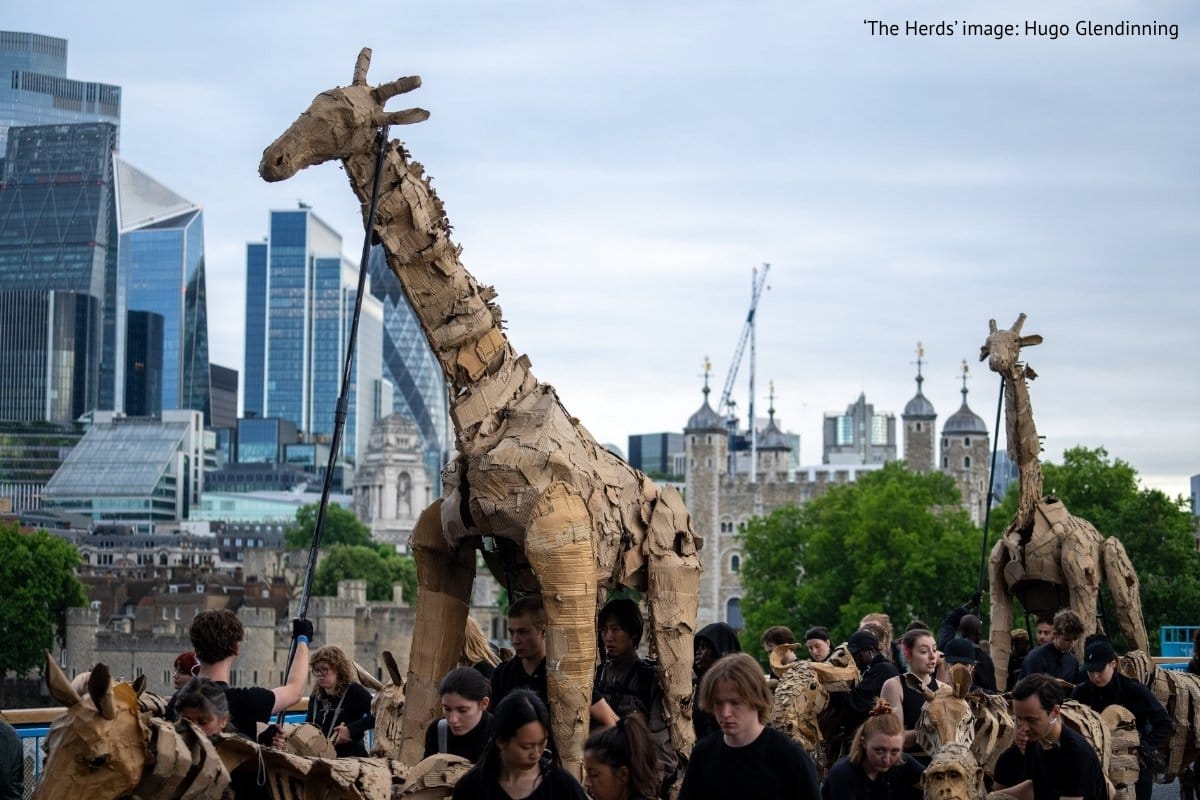
15. From April to August, a public art project of an unprecented scale saw life-size animal puppets take a 20,000km journey from the Congo Basin to the Arctic Circle, to highlight the impact on climate change on the displacement of animals. ‘The Herds’ (which included giraffes, antelopes, lions, and elephant puppets made from recycled materials, such as cardboard and plywood) captivated audiences in the streets, while bringing attention to the climate crisis by reflecting the migration of animals fleeing disaster.
16. Wicken Fen, in Cambridgeshire, has made history as the first UK nature reserve to host 10,000 species.
17. The two medieval towers of the Notre-Dame Cathedral, in Paris, have reopened to the public, six years after a fire tore through the landmark.
18. In June, EU lawmakers voted in favour of banning airlines from charging passengers for hand luggage (up to 7kg).
19. There’s been a 27% decline in people smoking across the globe since 2010, the World Health Organisation reports.
20. Scientists in South Korea have developed a liquid robot that aims to replicate the ability of natural cells to divide, fuse, deform, and capture other substances. The research, published in Science Advances, highlights how the ‘soft robot’ is comparable to a water droplet, able to recover it’s form without breaking. It’s thought these characteristics mean it could be used for targeted drug delivery inside the human body, but also has the potential to be developed further thanks to it being able to pass through narrow spaces – such as being used in disaster areas to support exploration, cleaning, and supplying nutrients.
21. An amendment to the General Wildlife Law has been unanimously approved by the Mexican senate, banning the use of marine mammals in captive entertainment, along with prohibiting captive breeding, or keeping of them for any purpose other than scientific research for conservation.
22. Mitch Hutchcraft, an ex-Royal Marine from Cambridgeshire, completed a gruelling 240-day triathlon in May. The 31-year-old raised money for charity SAVSIM (which uses animals and nature to provide mental health support to military vets), by swimming the 35km of the Channel from Dover, cycling about 12,000km from Europe to Digha in India, and then running 900km to Kathmandu in Nepal. He continued by trekking 360km to Everest basecamp, before scaling the mountain.
23. Engineers from Northwestern University, in Illinois, USA, created the world’s smallest pacemaker, which can be non-invasively injected into the body via a syringe. While it can work on hearts of any size, it’s particularly suited to newborns with congenital heart defects, and dissolves when no longer needed.
24. Some wear a gym kit! Javeno McLean is a personal trainer who recently won a Pride of Britain Award for his efforts to create inclusive workout spaces. He provides free sessions for hundreds of people each year – including those who are elderly, disabled, or ill, such as cancer patients, stroke survivors, and those with dementia – at his specially-equipped gym in Manchester. Judges said: “Javeno’s positivity and power to motivate just shine through in everything he does. He is genuinely changing lives, and inspiring millions.”
25. Whether you’re partial to a deep-pan or prefer a stone-baked thin crust, we have good news for pizza lovers. A study from the University of East Anglia has found that the smell of freshly baked pizza isn’t just a cause for salivating, but actively works to reduce stress and boost your mood. But, even if you’re not a fan of the food, the research suggests other familiar, comforting smells could still help to improve mood by up to 40%!
26. An overhaul of Scotland’s justice system is set to see the controversial ‘not proven’ verdict scrapped. The third verdict option has been unique to Scottish courts, and effectively sees the same result as ‘not guilty’, with the accused being acquitted. However, it’s believed that the ambiguity around being ‘not proven’ could be more traumatising for victims, and prepetuates stigma for the accused.
27. With concrete being the most used material on the planet (after water), scientists from Texas A&M University have developed a fully sustainable way for concrete to ‘heal’ its cracks itself, using synthetic lichen – improving on existing bacteria methods that aren’t fully autonomous.
28. Installing safety nets on the Golden Gate Bridge, in San Francisco, saw a 73% reduction in suicides in 12 months. Researchers reviewed the impact of these measures, along with that of training staff and volunteers to intervene when someone is showing signs of a suicidal crisis, and published findings in the journal Injury Prevention.
29. Time Out has revealed the ‘coolest neighbourhoods in the world’, with Jimbocho (Tokyo) putting the country on the map in the top spot. The top five are rounded out by Borgerhout (Antwerp), Barra Funda (Sao Paulo), Camberwell (London), and Avondale (Chicago). Travel itinery, sorted!

30. A new bill in california will define, and then ban, ultra-processed foods from school dinners. This is believed to be the first statutory definition of uPFs in the world.
31. Ed Sheeran launched a foundation to support music education in the UK, with the aim of improving access to music for 12,000+ youngsters. It will provide instruments, create performance opportunities, and hopefully open pathways into the industry, as well as advocate for greater recognition of music’s “transformative power”, along with the “essential” role of music teachers.
32. Microsoft founder Bill Gates announced that he will give away 99% of his fortune (expected to reach £150 billion) by 2045, through his foundation, primarily focused on improving health and education services in Africa, over the next 20 years.
Comments